
DEP – Cohort 3
Tracking Participation & Contribution
Three tabs record what actually happened each week.
Attendance Grid
Each week the DAO holds a short check-in. In the Attendance Grid you type only two things: Held? (Yes once an event has happened) and, for each member, whether they Joined each event. Everything to the right calculates itself — a per-phase score, an attendance rate, a band, and whether the member cleared the phase.
The scoring reads the rate, not the raw count, so it stays fair however many events are held — and it counts a member only from the events on or after their join date, so joining late is never a penalty.
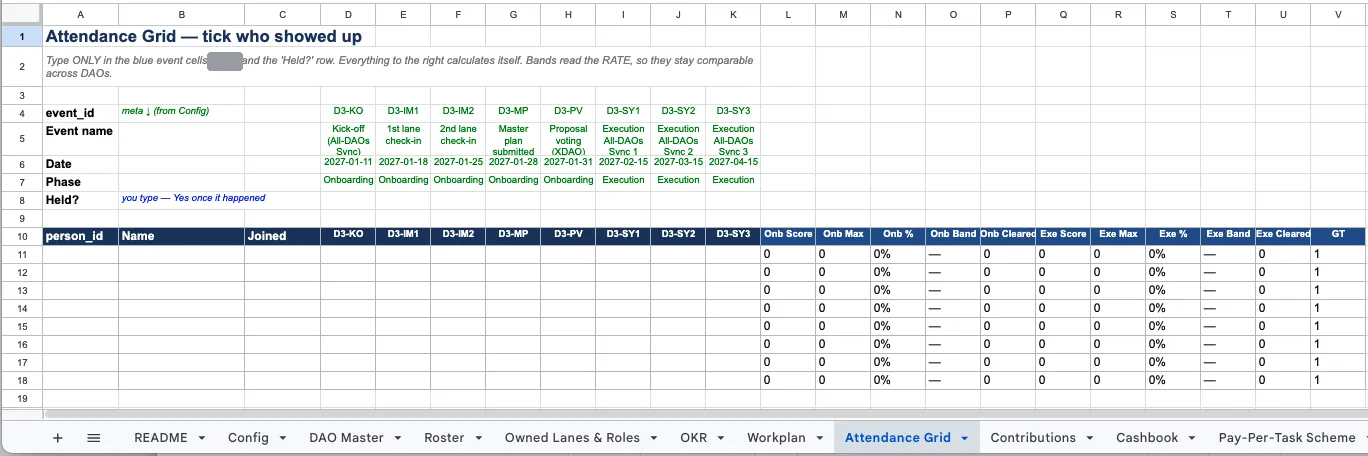
Screenshot: the Attendance Grid tab. Source: the DAO Workbook template.
Contributions
Contributions is where a deliverable is verified and, if it is a paid task, becomes payable. It records every deliverable — paid or not — against the standard set in the Workplan. For each one you type the person, lane, the deliverable and its link, and the three review checks: the lane owner, the DAO Lead, and the Facilitator each confirm it meets its Definition of Done. When all three confirm, the deliverable is Verified — an objective state, not one person's call. Unpaid work is logged the same way and still counts; it simply leaves the task_id, share, and amount blank. The verified, payable amounts total at the bottom, and that total is what the Cashbook reconciles against.
Verification binds payment. Once a paid deliverable is Verified — all three reviewers have confirmed it against its Definition of Done — the payment it carries is owed. From that point it is not reversible by any one person: not the lane owner, not the DAO Lead, not the Facilitator. It does not depend on the contributor still being in the DAO at payout — a deliverable verified while someone was a member is paid even if they later leave. This is deliberate. Work that was done and checked has been earned, and the DAO stands behind that.
A written confirmation goes to the whole DAO. When a deliverable is Verified, a short confirmation is sent to the whole DAO — naming the deliverable, the contributor(s), and the amount owed — and the date it was sent is recorded on the row. This does two things: it makes the verification transparent (everyone sees what was accepted and what will be paid), and it fixes the record, so a payment cannot later be disputed on the quiet. A deliverable that has been verified and confirmed is settled at the next monthly payout as a matter of course.
The confirmation is a notification to the DAO's shared channel and/or an email; in the Workbook it is a field on the Contributions row (see the tab spec). Sending it can be automated by the team's script or done by the DAO Lead or Facilitator until it is — either way, the row is not complete until the confirmation date is filled.
When two people share a deliverable. A deliverable done by two people is logged once as one deliverable, with both contributors recorded against it and a share for each — equal by default, or a stated split the pair agree, summing to the deliverable's amount. The three review checks apply to the whole deliverable; the split only divides the one payment. At settlement, each contributor is paid their share directly, so each has their own payout on the record — and if one later leaves, the other's share is unaffected. The split is visible to the DAO in the same confirmation that announces the verification.
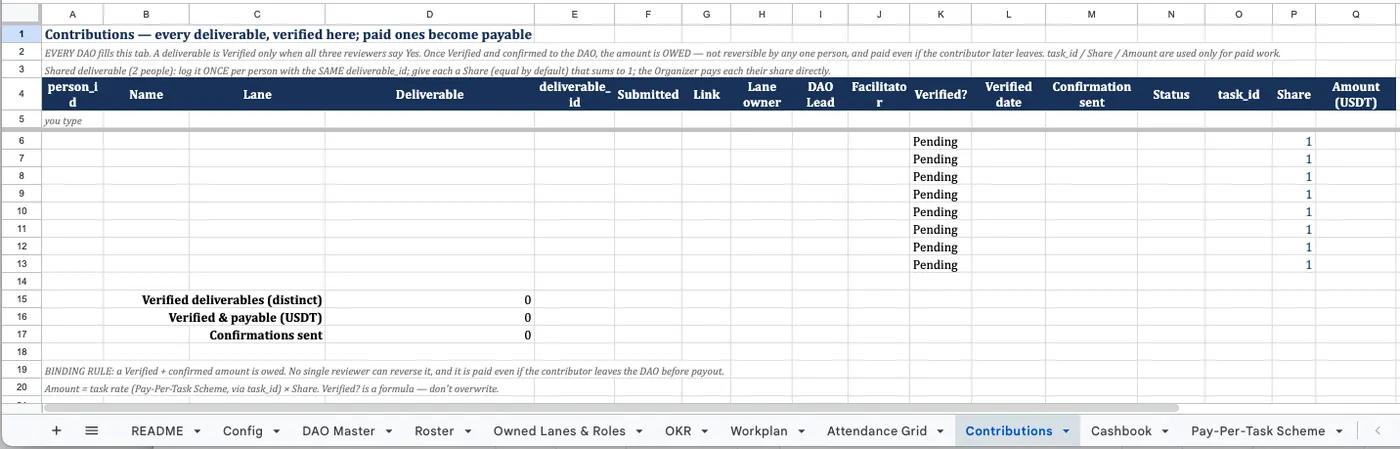
Screenshot: the Contributions tab. Source: the DAO Workbook template.
Lane Weekly
Lane Weekly is a Google Form response sheet — don't type into it directly; submit the form. One form serves the whole cohort. It's the tab that captures why, not just who: each lane's summary, blockers, and what it needs. A rising gap in a member's activity plus a named blocker here is exactly the kind of thing the weekly check-in is there to catch early.
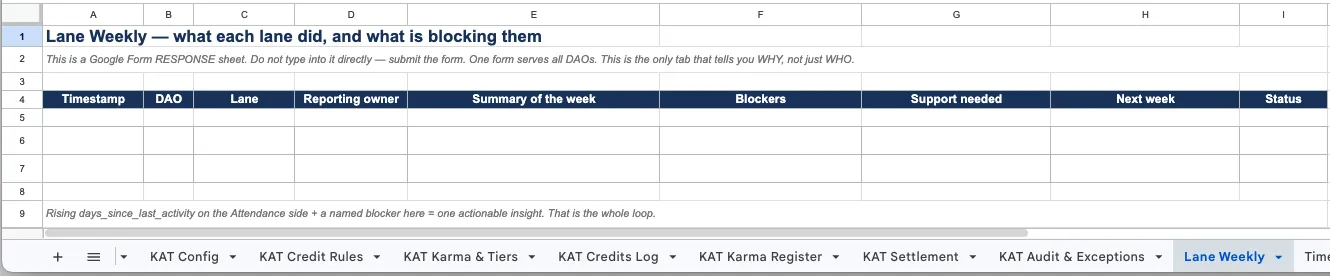
Screenshot: the Lane Weekly tab. Source: the DAO Workbook template.