DEP – Cohort 3
Categorisation & Revenue Split
This page explains what happens to revenue once it's received: how it's labelled, and how it's divided.
Revenue categories
Every payment is tagged with a Revenue Category — for example Service or Product. Categories are chosen from a set list rather than typed freely, for a simple reason: it keeps reporting consistent and makes splits predictable. The DAO's available categories are part of its configuration, set by its Organizer.
The split: dividing revenue into pools
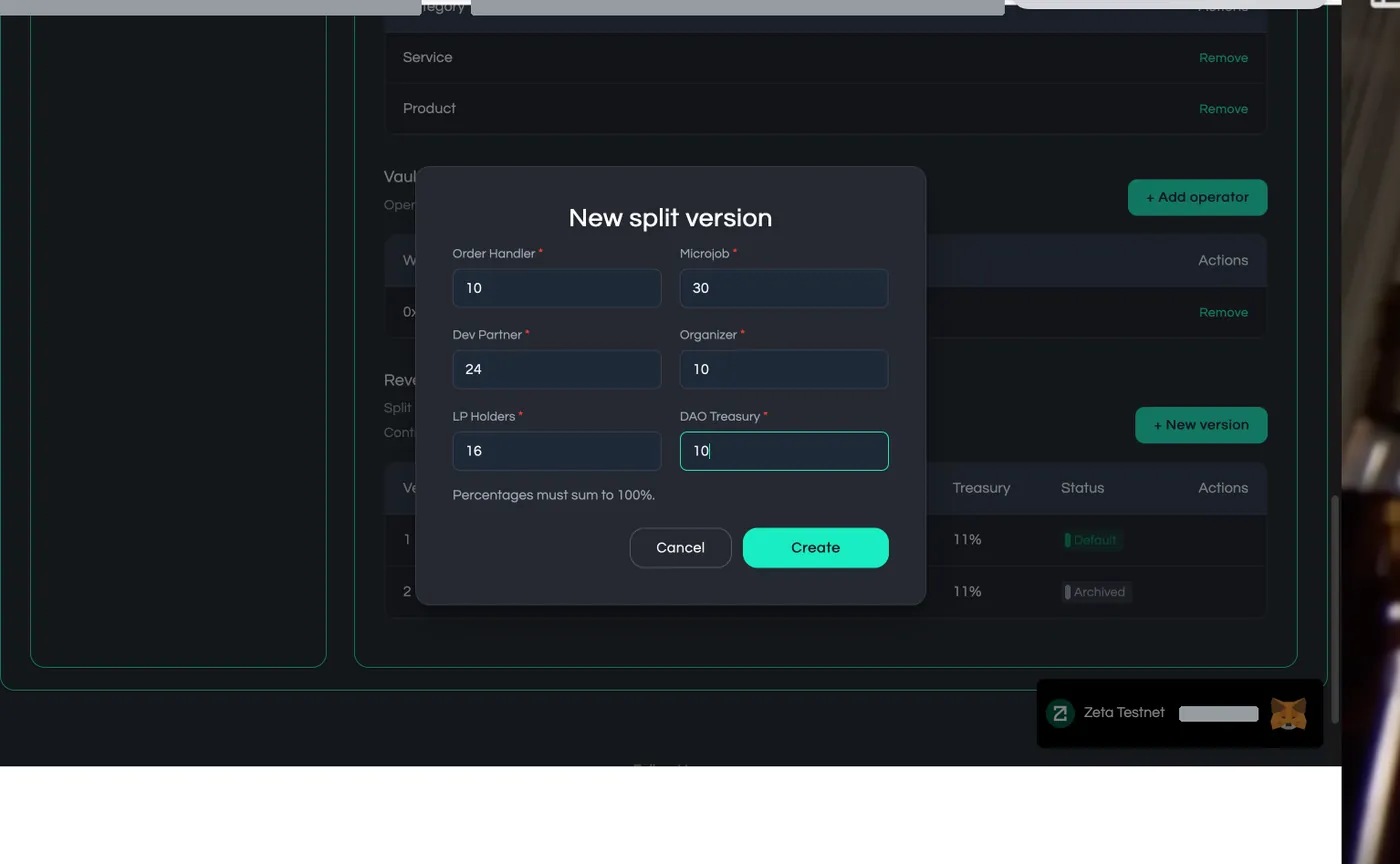
When revenue is confirmed, the framework divides it according to the DAO's Split Configuration — a rule the DAO's Organizer sets in advance. The rule is:
- Predefined — set once, before revenue flows, not negotiated per payment,
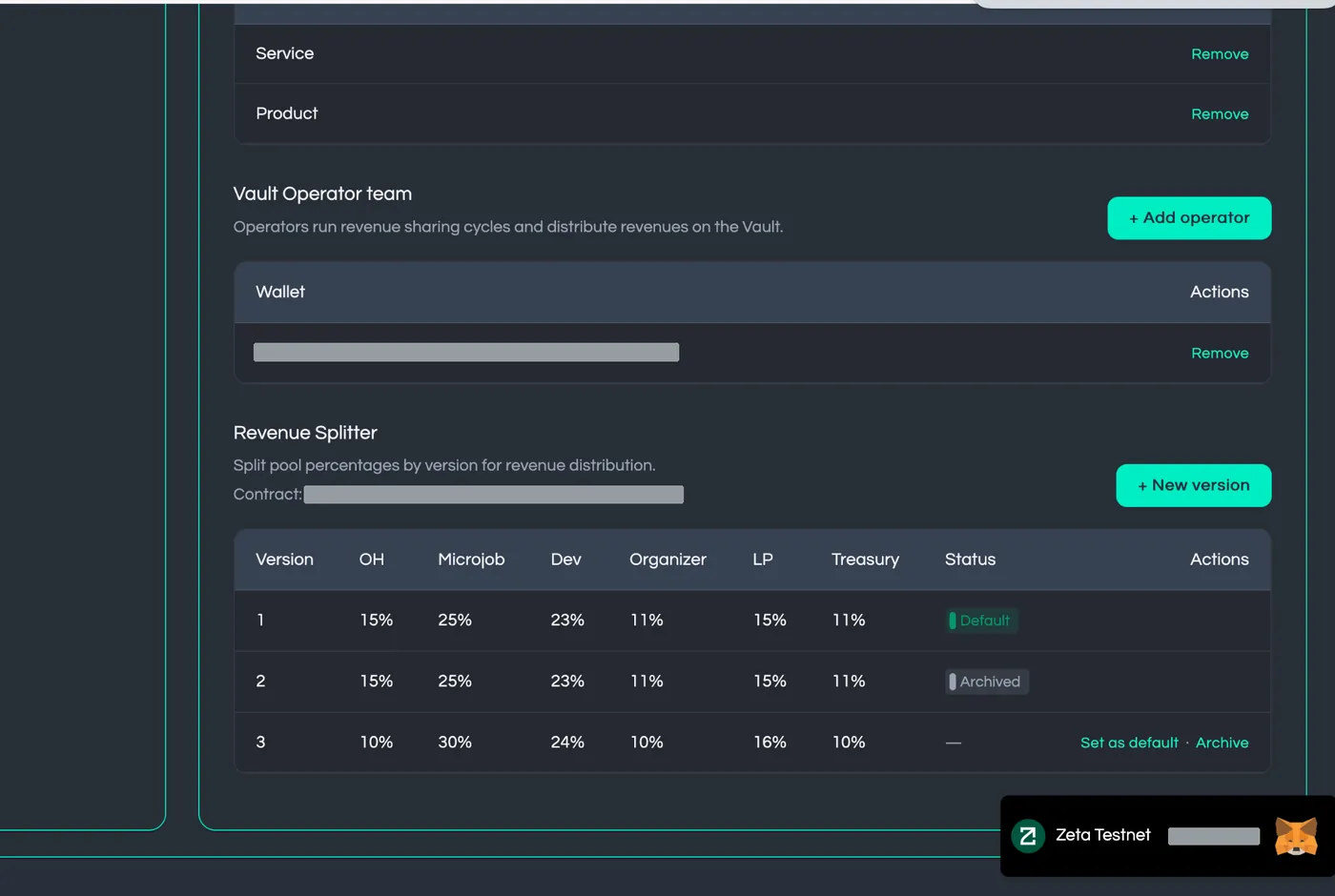
- Versioned — any change is explicit and recorded, so past splits stay reproducible,
- Deterministic — the same input always produces the same result.
The split divides revenue among pools. The framework supports up to six pool types; the DAO configures which pools it uses and what share each gets — a simple setup might use two or three, a more complex one all six.
| Pool | Who / what it's for |
|---|---|
| Microjob | Work contributors — funds pay-per-task payments to members who did the work (see *Paying Contributors & Operating Costs*). |
| Order Handler | Members who handled the orders behind the revenue — revenue sharing by attribution (see *Order Handler Revenue Sharing*). |
| Organizer | The DAO's organising role. |
| Dev Partner | A development partner's share, where one is engaged. |
| LP Holders | Fund contributors — those who put in seed capital or cash sponsorship (roughly 1 USDT ≈ 1 LP). |
| Treasury | The DAO's own reserve, for operating costs and future work. |
The share to each pool is the DAO's decision, made in its master plan and set in the split configuration — not a number handed down by Kambria. What the framework guarantees is that whatever rule the DAO sets is applied automatically, identically, every time, and recorded.
A standard split for DEP 3
The framework supports up to six pools; the DAO configures which it uses and what share each takes, set in its master plan and changeable by governance. For DEP 3, Kambria provides one standard split for the Circles DAO to start from.
What each pool is for
| Pool | For |
|---|---|
| Order Handler | Members who bring in and handle orders (referral, sales, support) — split equally across the handlers on each order |
| Service Provider / Microjob | Members who deliver the service for the order (e.g. a session, a produced piece of work) |
| Dev Partner | The party that built and maintains the core platform the service runs on — used *only* where such a partner exists |
| Organizer | The organising role (currently Kambria) |
| LP Holders | Fund contributors (seed capital / cash sponsorship), pro-rata to LP held |
| DAO Treasury | The DAO's own reserve — operating costs and future work |
On the Dev Partner pool
In DEP 3, the three selected projects keep their own IP and work with the Circles DAO through their houses on Kambria Circles — they do not license their product to the DAO (see IP Framework for DEP 3 DAOs). So a selected project is not a "Dev Partner" and does not take a licensing share of the DAO's revenue: the project's return is the scaling of its own impact through the DAO and its community.
The Dev Partner pool applies only where an actual development partner built and maintains the platform. Kambria built and keeps the IP of the Kambria Circles platform; it is not licensed to the DAO. So for this cohort, any Dev Partner share is directed to the DAO Treasury rather than paid out as a licence.
The standard configuration for the Circles DAO
The Circles DAO uses the same six-pool configuration as CED did. Kambria built and maintains Kambria Circles, so the Dev Partner pool is reserved to Kambria; because the IP is not co-owned by the DAO, that share is directed to the Treasury in DEP 3. The Dev Partner share folds into the Treasury, which early on funds the push the DAO needs most: outreach — bringing people to Kambria Circles and the three project houses, and finding sponsors.
| Pool | Share | Note |
|---|---|---|
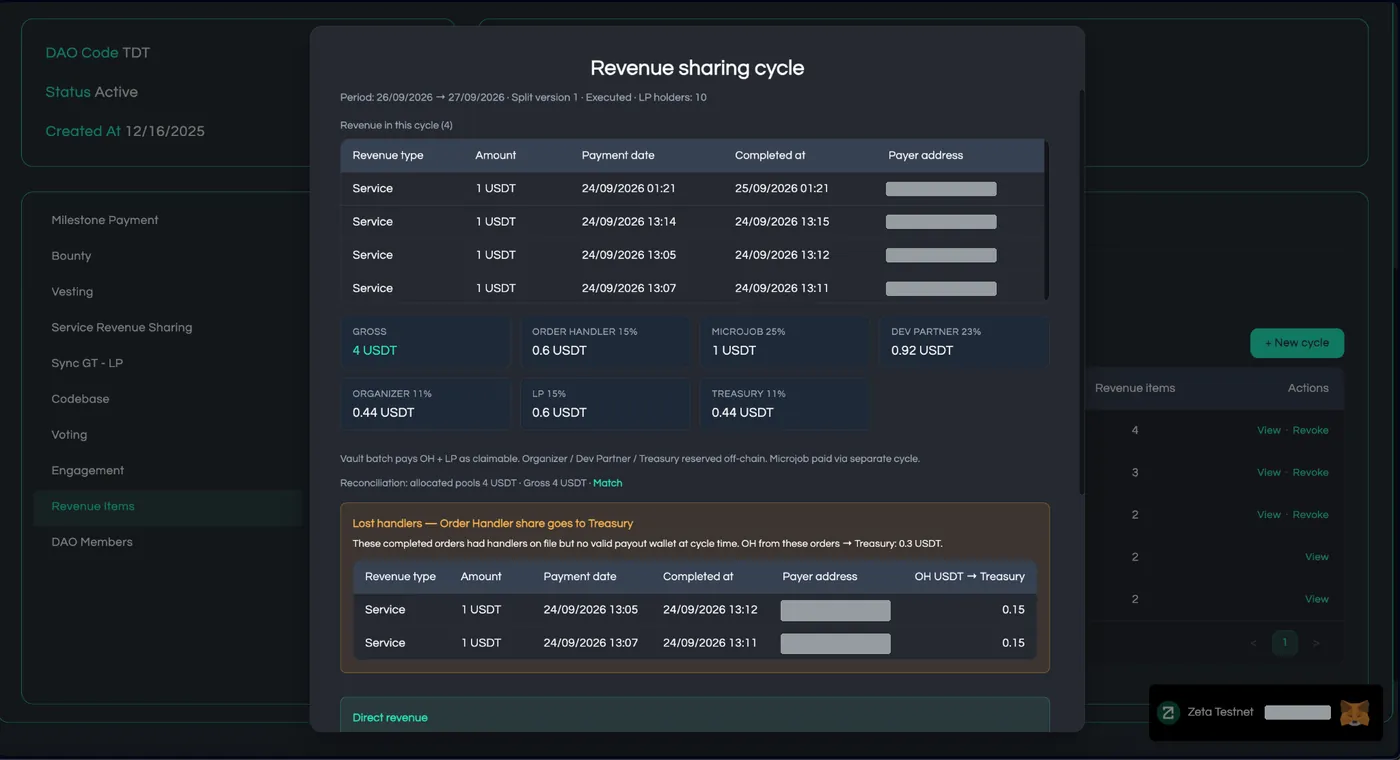
| Order Handler | 15% | |
| Service Provider / Microjob | 25% | |
| Dev Partner | 23% | Kambria (reserved); directed to Treasury in DEP 3 — IP not yet co-owned |
| Organizer | 11% | Kambria |
| LP Holders | 15% | |
| DAO Treasury | 11% | *(+ 23% Dev Partner = 34% effective this cohort)* |
| Total | 100% |
Closing a cycle
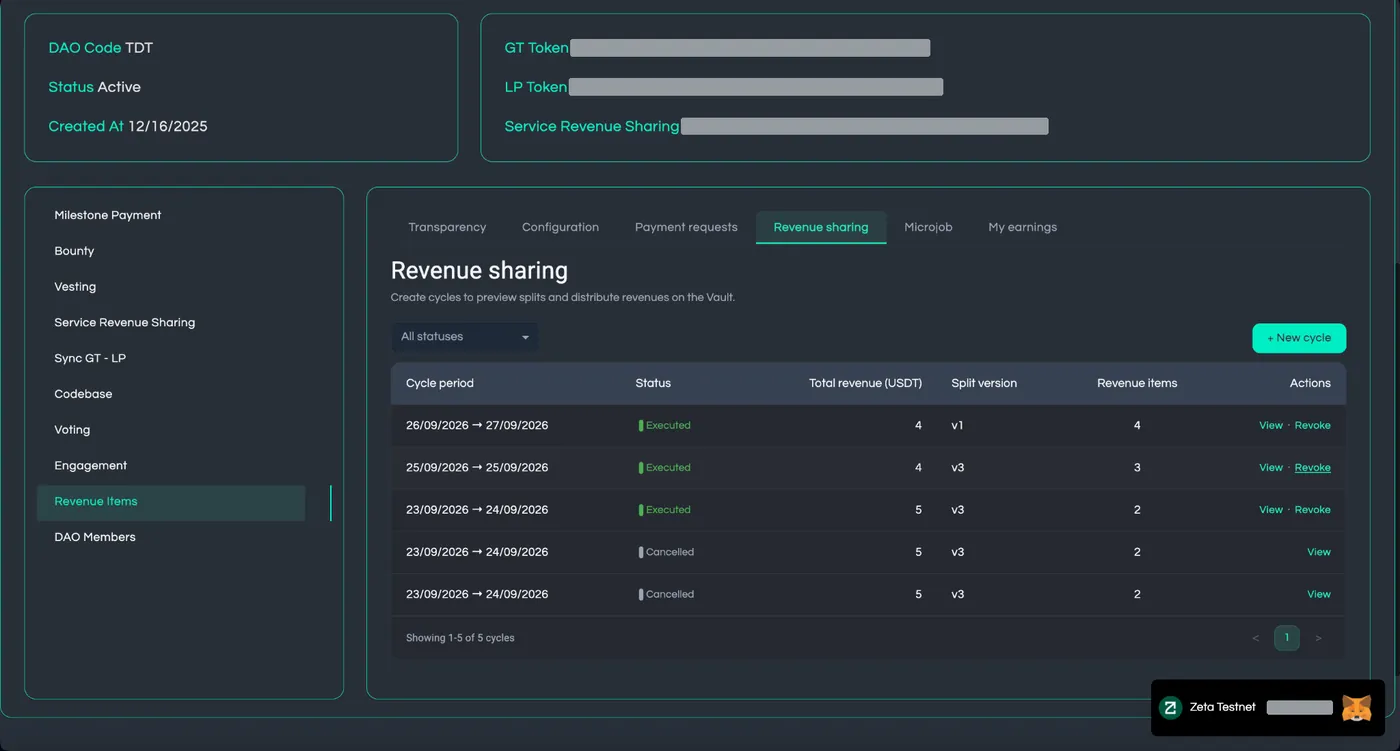
Revenue is split and paid out per cycle (weekly or monthly), not per individual payment. The Operator closes a cycle in the app in this order:
- Choose the period the cycle covers.
- Select the revenue items from that period to include.
- Choose the split version to apply.
- Preview. The framework shows the cycle summary: the gross revenue and the amount going to each pool. Nothing is locked yet, so the Operator can still go back and change the period, the items or the split version.
- Save for later, or distribute on-chain. Either step locks the cycle’s items and total. Distribute on-chain then carries out the distribution.
What happens to each pool in this cohort. Only the Order Handler and LP Holders shares are paid on-chain: they go into the Vault, and each recipient claims theirs in My earnings. The Organizer, Dev Partner and Treasury shares are reserved and settled off-chain in this cohort, and the Microjob pool is paid through its own, separate cycle (see Paying Contributors & Operating Costs).