
DEP – Cohort 3
How It Works
In Cohort 3 one DAO, the Circles DAO, moves through a clear process — from contributing on Kambria Circles, to joining, to organising into lanes, to creating value, to sharing what happened. This page walks through that process step by step. Several steps have their own detailed pages; this is the map that connects them.
Two things run underneath the whole process and are worth naming up front: the Kambria DAOs Framework*, which handles value and payments transparently and is being run in a live cohort for the first time; and the Owned Lanes model, the way the DAO organises its work so that members own outcomes rather than wait for tasks. Kambria Circles itself needs no wallet, token or payment; the framework is used only for the DAO's own money.*
1. Contribute, Then Join
Cohort 3 is formed in an order that matters. First, three social-impact projects are selected — chosen for having a working innovation, proven regeneration, and a real community behind them — and each opens a house on Open Circles at the DEP 3 Launch in January 2027. Anyone can then walk the street at circles.kambria.io, take a small task (5–30 minutes) at a house, and send their work; the house's lane checks it against its "Done when" rule, and the contributor hangs a lantern on the thank-you tree. The Kambria Circles Docs (circles.kambria.io/docs/) explain each step.
Then Kambria recruits the Circles DAO's 10–25 members. Once one of your tasks is confirmed, Apply to join the Circles DAO appears in My tasks; in the application you share your background, the kind of work you're drawn to, and your availability. Priority goes to people who have already contributed, and people from the selected projects can join too.
Returning participants from earlier cohorts are warmly encouraged to take part, bringing their experience with them. Prior experience with Web3 is not required to join.
2. Onboarding & Workspace Setup
Once the DAO is formed in February 2027, members are set up with the tools the cohort runs on — Discord for communication, a Google Drive workspace, XDAO for governance and treasury, and the Kambria DAOs Framework for receiving and distributing value. Guides for each are in the Tools & Onboarding section.
Members also receive what they need to begin: an orientation to the DAO, the proposal templates, guidance on how contribution and payment work, and — for each lane — its Launch Kit.
3. Organise Into Lanes
The Circles DAO organises its work into owned lanes — each lane a pair, each with clear boundaries, each a continuing stream of work — grouped under a few broad scopes so the pairs stay pointed in shared directions. Kambria forms the initial pairs and lane assignments from members' interests and profiles, and the DAO includes onboarding work — welcoming and activating new members — as one of its lanes. (These are DAO lanes. On Kambria Circles, each house also has a lane: the people who check and confirm its tasks.)
This is the heart of how a DEP 3 DAO runs day to day. The Owned Lanes Model page explains it in full, and the Member Roles & Contribution page explains how members own, contribute to, or float across lanes.
4. Write the Master Plan & Lane Proposals
The Circles DAO writes a master plan: how it will pursue its goals, and — importantly — how it defines its own lanes. Deciding a DAO's lanes is the first real act of ownership in the cohort, the point where the shared model becomes this DAO's concrete shape.
From there, pairs write short proposals for their lanes — what they intend to do, and what they need to do. Members work on these under the guidance and preliminary qualification of the DAO Facilitators, drafting from Kambria's templates. The DAO Master Plan Proposal Template section has the templates and checklists.
5. Align, Submit, and Vote
Before the run begins, the DAO comes together in an Onboarding Sync to align and preview its proposals. From there, proposals move through a clear flow:
1. Proposals are submitted through the Create Proposal feature on XDAO.
2. DAO participants vote on the qualified proposals.
3. Approved proposals move into execution; the work goes ahead and is documented.
Once work is underway, the seed funding is released monthly, along two different paths depending on what it's for:
Contributor payments. payments to contributors for the work they do are released through the Kambria DAOs Framework, per task — the system computes what's owed and the contributor is paid directly, on the record.
Operating costs. costs that aren't tied to one person's task — a venue, a tool, a community micro-grant — are released from the DAO treasury to the DAO Lead or treasurer to spend, with receipts and documentation.
The Circles DAO receives $3,000 in seed funding from Kambria for the whole DAO, released monthly rather than all at once — supporting careful planning, iteration, and transparency along the way.
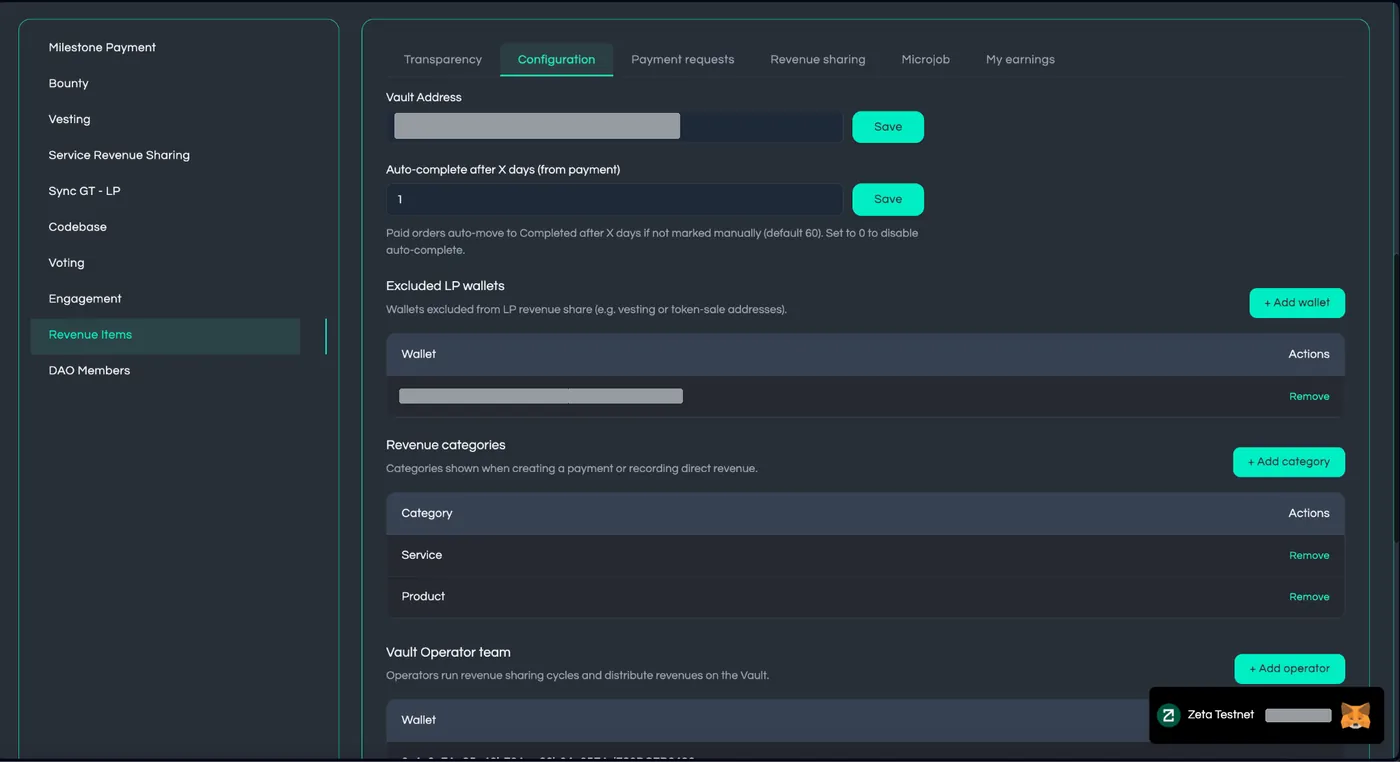
The seed is starting capital for scaling impact, not a loan to be repaid. Unlike earlier cohorts, there is no target to earn it back. Using it well is measured by what it helps the DAO scale — the impact axes on the Measuring What Matters page — not by how much revenue returns.
6. Create Value
This is the longest stretch of the cohort. The Circles DAO helps Kambria Circles reach more people, supports the three project houses (each aims for at least 10 verified tasks a month from March, with a monthly impact report), finds 3–5 sponsors for the houses and Local events, and prepares a real Local event at a selected project's place. At the mid-season check at the end of April, the DAO chooses the project for the Local event and compares the houses it supports with houses that projects run themselves. In May–June, members also complete Practice Circles Season 1.
The DAO has clear goals — contributors, verified tasks, sponsors, a Local event — but what returns in money is observed, not chased. The Concept Note explains the thinking behind this.
7. Value Flows Through the Framework
When the DAO's own work brings in revenue in USDT, it flows through the Kambria DAOs Framework rather than being handled by hand. Sponsorship of a project house or a Local event works differently: Kambria agrees the terms and sends invoices outside the Circles website, the money goes to the project. Kambria keeps a fixed fee of 15% of each sponsorship, whoever brought the sponsor in, and the rest (85%) goes to the project. If the Circles DAO brought the sponsor in, Kambria pays the DAO a referral fee of 5% of the sponsorship, in USDT, out of its own fee, as DAO revenue split through the framework. For DAO revenue in USDT:
Received. Payments are received in USDT against a request, each recorded with its source, amount, time, and DAO.
Categorised. Each payment is tagged by type, so reporting is consistent over time.
Split. A predefined, versioned split rule is applied automatically — no spreadsheets, no per-transaction arithmetic.
Paid out. Those due are paid directly, with amounts computed by the system, and every step visible in the logs.
Because this is the framework's first live cohort, Kambria runs it hands-on — with close support and manual checks alongside the automation until it has earned trust.
8. Rhythms and Alignment
The cohort keeps two regular rhythms. Each week the DAO has a short check-in, facilitated by Kambria, where each lane updates on how it's moving and anything stuck is caught early. About once a month the whole DAO gathers in the Circles DAO Sync, where each pair presents what their lane will focus on next and tells the story of the period just gone — so everyone sees each other's work and moves as one. The Kickoff that opens the cohort and the Showcase that closes it are the first and last of these gatherings.
Weekly updates keep each lane visible, but they don't, on their own, make the lanes work together. So alongside them, lanes align around shared activities. When the DAO takes on something that needs several lanes at once — a campaign, a launch, a community push — an activity plan sets the shared goal and shows how each lane contributes to it, so the lanes move together rather than in parallel. This is how cross-lane collaboration becomes concrete rather than hoped-for.
Not every week carries a deliverable — space to absorb and integrate is deliberate — but the DAO stays in weekly contact throughout. The Owned Lanes Model page describes the rhythms and how lanes align.
9. Payment & Recognition
Contribution is recognised in two ways. People who do work are paid for it, per task through the framework, as described above. Alongside payment, contributions are recognised with KAT — a symbolic, non-financial token that records participation and standing in Kambria, including the many contributions that aren't a paid task, like welcoming a new member or helping another lane. The Member Roles page and the KAT in DEP 3 page cover both. Contributors on the Kambria Circles street are not paid; they are thanked with a lantern on the thank-you tree.
10. Updates & Field Notes
The Circles DAO publishes a monthly DAO report, and each project house a monthly impact report, alongside regular updates on how the work is going — progress, stories, experiments, challenges, and what's next — so the cohort stays visible to itself and to the community following along.
Alongside the numbers the framework and Kambria Circles record, the DAO keeps field notes: the things that don't show up as revenue but matter to the story — a referral that arrived unasked, a collaboration that formed on its own, something that returned in a form other than money. Both are part of what the cohort learns.
11. Reflection & Showcase
Near the end of the cohort, members reflect on their experience — what they made, what surprised them, what they learned about working this way — and the DAO brings its work together for a showcase: outputs, stories, results, and honest learnings, including what didn't work.
The showcase is the final Circles DAO Sync, and it marks the completion of Cohort 3.
Pages in this part
- The Owned Lanes ModelThis page explains how work is organised inside the Circles DAO, the one DAO of DEP 3. It is the heart of what is new in this cohort. Templates you can fill in — the Launch Kit, the Circles DAO Sync agenda — live on…
- Member Roles & ContributionThis page explains how members take part in the Circles DAO, how people move between ways of contributing, and how contributions are recognised. It builds on the Owned Lanes Model page, which describes how the DAO's…
- Measuring What MattersHow does the Circles DAO know whether it's succeeding? This page answers that. It sets out what Cohort 3 measures instead of revenue, the Circles DAO's four goals and its OKRs for January–June 2027, and how each lane…
- KAT in DEP 3Not everything that matters in a DAO is a paid task. Welcoming a new member, helping another pair, shaping a proposal, showing up — these keep a DAO alive, and KAT is how they are recognised. This page explains what…
- IP Framework for DEP 3 DAOsIn DEP 3, three kinds of intellectual property meet: the Kambria Circles platform, which Kambria built; the working solution each selected project brings in; and the new work the Circles DAO creates while scaling…
- DAO Funding GuideA plain-language guide to the Circles DAO's money — where it comes from, where it goes, and how it stays honest. Contributors on the Kambria Circles street are not paid and handle no money (they are thanked with a…