
DEP – Cohort 3
DAO Funding Guide
A plain-language guide to the Circles DAO's money — where it comes from, where it goes, and how it stays honest. Contributors on the Kambria Circles street are not paid and handle no money (they are thanked with a lantern); this guide is about the DAO's own funds. The mechanics live in the DAO Operations Excellence pages (the Kambria DAOs Framework and the DAO Workbook); this is the overview that ties them together. Each section links to the details.
Two sources of money
The Circles DAO's money comes from two places, and they behave differently:
- The seed — $3,000 from Kambria. One seed for the whole Circles DAO, not one per project: starting capital for the DAO's work, released monthly. It is the DAO's to spend on its work for Kambria Circles and the three project houses, and it carries no obligation to be earned back. (It is not paid to any project — see below.)
- Revenue the DAO earns. Money from the DAO's own work, in USDT, received and split automatically through the framework. Sponsorship of a project house or a Local event works differently: Kambria agrees the terms with the sponsor and sends invoices outside the Circles website, in normal currency (fiat); the money goes to the project, and the website shows only the sponsor's name, logo, website and counts, never amounts. The Circles DAO finds and looks after sponsors. Kambria keeps a fixed fee of 15% of each sponsorship, whoever brought the sponsor in, and the rest (85%) goes to the project. If the Circles DAO brought the sponsor in, Kambria pays the DAO a referral fee of 5% of the sponsorship, in USDT, out of its own fee; the sponsor pays nothing extra, and the referral fee is DAO revenue, split through the framework. For a large sponsorship, the referral fee may be capped (for example at 250 USDT per sponsor), or Kambria's fee lowered for amounts above $5,000. This is sponsorship with brand recognition, not a donation, and the referral fee comes out of Kambria's fee, never out of the project's share — so the project receives the same amount whoever brought the sponsor in.
The two stay separate on the books: the seed is planned in the Budget Plan and spent on the DAO's work; earned revenue flows through the split. Keeping them distinct is what lets a DAO see what it was given versus what it made.
Where the seed sits — Kambria's LP
The seed is Kambria's fund contribution into the DAO. In return, Kambria holds LP — a fund-contribution stake (roughly 1 USDT ≈ 1 LP) — and shares pro-rata in the DAO's revenue through the LP Holders pool, the same way any cash sponsor who puts money in would.
Two things follow, and they sit together without conflict:
- The DAO doesn't repay the seed. There is no revenue target and no loan to return; the DAO spends the seed on its work.
- Kambria participates in the upside. If and when the DAO earns revenue, Kambria — as an LP holder — shares in it through the LP Holders pool, alongside any other fund contributors.
This is an investment into the DAO*, not money paid to any project: Kambria's stake is in the Circles DAO, and it takes no equity in the three selected projects. (See the* Terms & Conditions for Projects, clause 4.)
Where the money goes — two paths out
Money leaves the DAO along two different paths, because two kinds of spending behave differently:
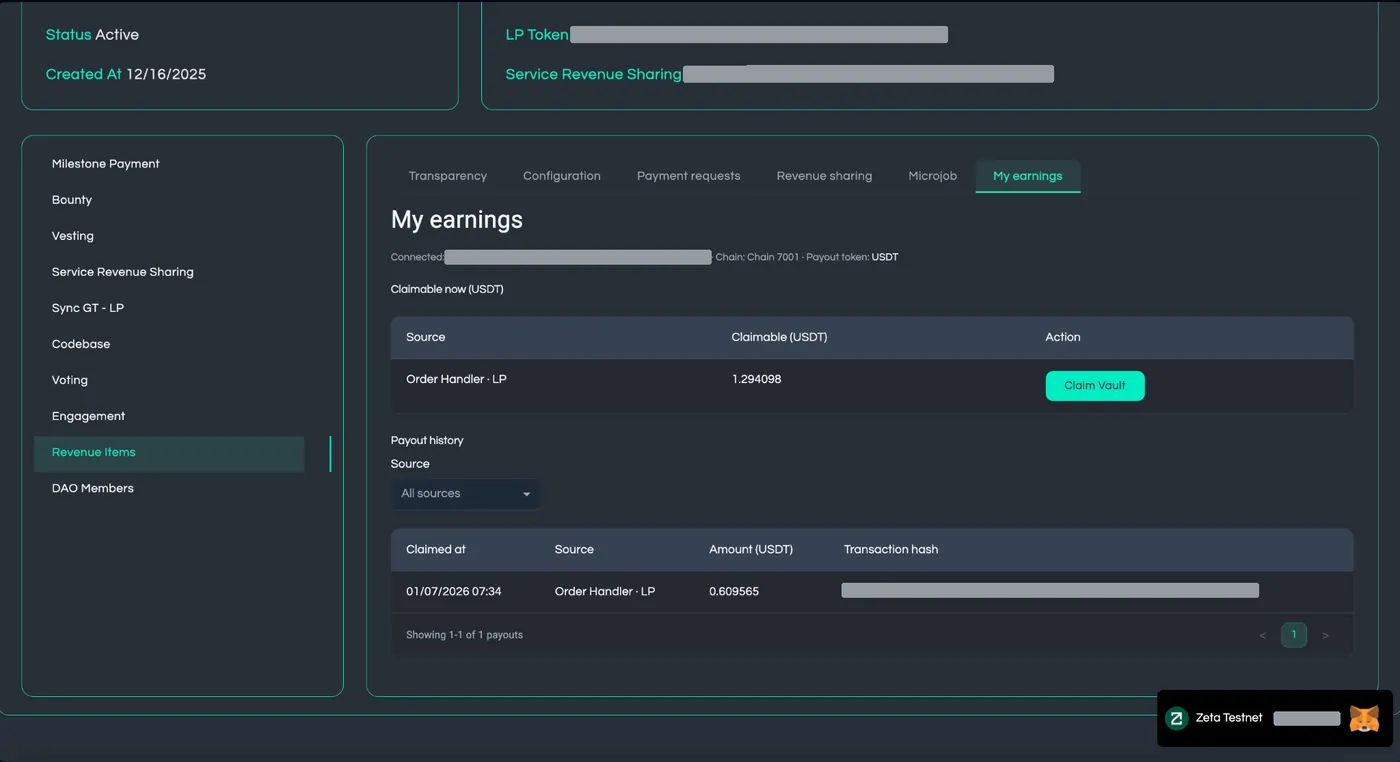
- Contributor payouts — pay-per-task. Circles DAO members are paid in USDT for completed, reviewed-qualified deliverables, from the Microjob pool, settled monthly through the framework. Pay follows the qualified deliverable at its rate, not time spent or volume of activity. See Paying Contributors & Operating Costs.
- Operating costs — a treasury vote. Costs not tied to one person's task — tools, hosting, a venue, community micro-grants — are released by a DAO vote to the DAO Lead or treasurer, against receipts. See Paying Contributors & Operating Costs.
Both are planned up front in the DAO's Budget Plan, split into these two parts against the $3,000 seed. Small tasks on the Kambria Circles street are not part of either: they are unpaid, confirmed by the house's lane, and thanked with a lantern.
When the DAO earns revenue — the split
Revenue the DAO earns is received, categorised, and divided automatically by the DAO's standard DEP 3 split into its pools — Order Handler, Microjob, Organizer, Dev Partner, LP Holders, and Treasury. What each pool is for, and the standard shares the DAO works from, are on Categorisation & Revenue Split.
This earned revenue is separate from the seed: the seed funds the work; the split distributes what the work brings in.
The project's return
For each of the three selected projects, the return is its solution scaled — more contributors at its house, more reach and depth, business development through the community — and the sponsorship for its house or Local event, which goes to the project. It is not a cut of the DAO's revenue, and it is not the seed. (The builder keeps its IP; a share of service revenue only ever arises through a genuine co-ownership or licensing arrangement, which is not part of DEP 3 — see Categorisation & Revenue Split and the IP Framework.)
Keeping it honest
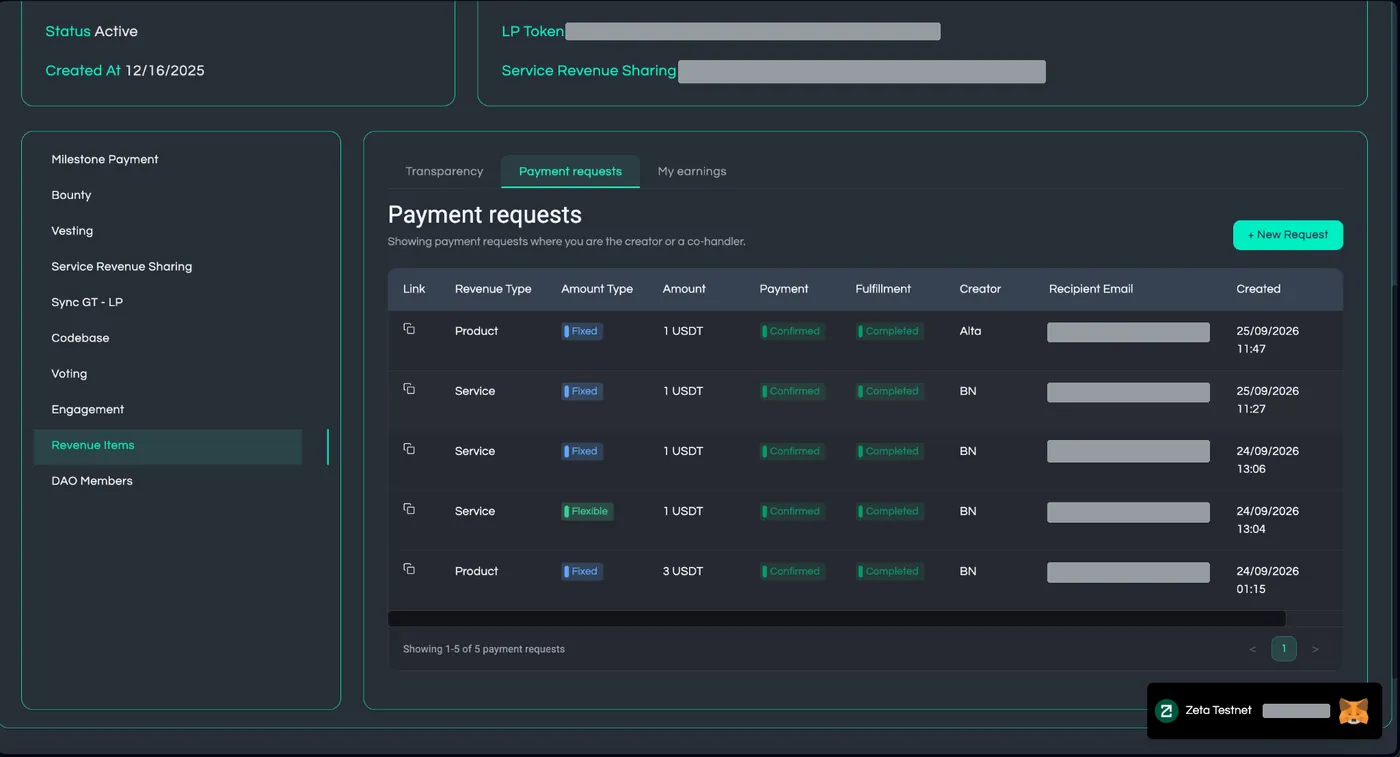
Everything is recorded: the framework logs every receipt, split, and payout on-chain; the Workbook's Cashbook mirrors those records rather than re-recording them; and the two are reconciled every month. Nobody has to take anyone's word for the numbers: the Circles DAO records at least 90% of its income and spending publicly and publishes a monthly DAO report. See Transparency & Reconciliation.
For the full mechanics, see the DAO Operations Excellence section — the Kambria DAOs Framework (receiving, splitting, paying out, on-chain) and the DAO Workbook (Budget Plan, Pay-Per-Task Scheme, Cashbook).